Showing posts with label Carboniferous. Show all posts

Friday, 18 January 2013

The geological history of the British Isles (part 2)

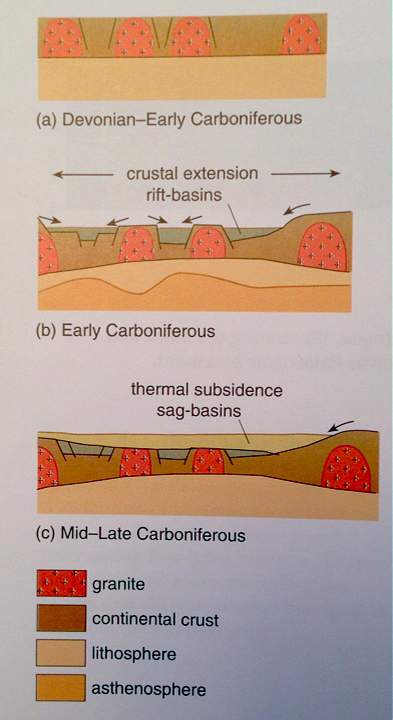
The Caledonian Orogeny produced highlands (Southern Uplands, Anglo-Brabant, Welsh) by crustal shortening and uplift. Post orogenic granite blocks such as the Alston and Askrigg were also emergent. These persisted while crustal extension in the early Carboniferous created a series of rift basins around them. When rifting slowed the thermal relaxation of the crust led to thermal sag basins.
 

The geological history of the British Isles (part 1)

To put the Carboniferous into context I re-read the Open University book in the title of the post. I possess no artistic skills at all but have drawn the following cartoons which shows the main stages with no reference to paleolatitude. They are obviously not to scale or the correct shape either!

Scotland and the rest of the British Isles are on different landmasses
Avalonia separates from Gondwana and begins its journey across the Iapetus
The Iapetus closes, the Rheic opens
Laurentia, Baltica and Avalonia collide in the Caledonian Orogeny as the Iapetus finally closes
The Rheic closes and Pangea forms in the Variscan Orogeny


Friday, 28 December 2012

Visean and Dinantian

According to an earlier blog on the Carboniferous the Dinantian is a series and the Visean a stage. According to the BGS book The Pennines and adjacent areas (p16) the Dinantian is a subsystem and the Visean a series which is divided into stages:

I am more inclined to believe the BGS over Wikipedia!

Whichever is true the geology of the Peak District is often described as Dinantian, Namurian and Westphalian which is a mixture of subsystem and series (on the BGS criteria) with the occasional mention of the Visean. Geologists always seem out to confuse.


Saturday, 27 October 2012

Lepidodendron

There has been a fossilised tree root in Sheffield Botanical Gardens for as long as I can remember. It was not until they put up new signs earlier this year that it's significance became clear.


Clubmosses - fossilised plants that became coal

This is the fossil root of a giant clubmoss called a Lepidodendron that lived about 300 million years ago. It was found in the rocks between the coal seams that were dug out when Sheffield's railway station was being built in the late 1860s. Clubmosses were some of the earliest vascular plants. Today clubmosses still exist but they are small plants that usually grow in boggy areas. Fossils are usually formed when an organism dies and the contents of its cells are replaced with rock forming minerals. This fossil root was surrounded by hardened sediments before the tissues rotted away leaving a hollow mould which was filled with fine sand forming a perfect replica of the original root. During the Carboniferous period Sheffield was covered with vast forests of clubmosses that grew up to 30 meters tall. When they died they piled up and were turned to coal as they were buried and compressed. This coal was mined in the Sheffield area for fuel.

Friday, 28 September 2012

Carboniferous period - timescales

The backbone of our understanding of the geology of the Peak District will be built around the chronostratigraphic chart of the Carboniferous. Here is an extract showing the relevant data from the latest (2012) version of the International Chronostratigraphic Chart:


Confusingly these international names are not the same as the European Carboniferous system (from Wikipedia):
As all the books I have are about UK geology it is probably best to stick to the European system.